-
Now Is The Time For a ‘Great Reset’

The last time we went through a great reset was when the Covid-19 pandemic shut down the world in 2020. Great meaning “remarkable in magnitude,” as defined by Merriam Webster, not great as in how we commonly use it as “good.” For many it was far from great—brutal, even. Heartbreaking, challenging, a time of loss and confusion. Still, we can’t deny that our nation and world went through a reset of indescribable proportions.
Whether or not you’ve noticed that our country is going through its own reset—which is impacting the world at large—it seems to me that many of us are also going through our own personal resets, great or otherwise. Instead of just haphazardly dealing with life and circumstances as they come our way, what if we thoughtfully approached the different areas of our lives to see where we might shore up any weaknesses, while we’re able? What if we considered that our own personal reset was, in a sense, part of a revolution?
For me, the past month just about knocked me out and I quickly realized that I had not been properly prepared in a few areas. World events aside, I worked at my publishing job every day for more than three weeks straight to meet some aggressive deadlines, and also endured some major transitions on my team that left me both heartbroken and overworked with no help toward meeting those deadlines, pushing me once again into an unsustainable survival mode. This, while also navigating some highly unusual personal and financial situations. I felt like the systems and institutions I had relied on for years—or decades, in some cases—were no longer a source of stability, and I was beginning to feel like I was living in an alternate reality. In short, I was mentally and physically depleted.
Can you relate on some level?
Now that the dust is beginning to settle (at least in my work life), I’m suddenly in need of a decently sized, if not great, reset for myself. This calls for a look at my life and lifestyle. If you feel called for something similar, I invite you to join me on this little exploration.
Why bother?
Because, according to the great wisdom of Switchfoot, “We were meant to live for so much more.”
Lightheartedness aside, let’s not forget that. There’s more available than merely surviving—and it’s also okay if that’s all we’re doing right now.Subscribe
What We Can Borrow from the Pandemic Reset
Whether or not you’re ready for a major life overhaul, it seems to me that with our nation going through a massive transition, we’ll need to individually and collectively consider how to navigate these times. I sense the need for us to—shall we say—“get ahead of things” while we’re still able. Because when I think back to what the pandemic forced upon us, a few things come to mind as far as major lifestyle shifts that may prove to be useful now.
- Forced Slowdown: Lockdowns and restrictions forced many of us to slow down, spend more time at home, and re-evaluate our priorities. This led to a greater appreciation for simple pleasures, like spending time with family, connecting with nature, and pursuing hobbies.
- Increased Focus on Health and Well-being: The pandemic heightened awareness of health and well-being, leading to increased interest in exercise, healthy eating, and mental health practices.
- Strengthened Local Connections and Community: With travel restricted, many people rediscovered their local communities, supporting local businesses and building stronger connections with their neighbors. There’s a renewed appreciation for local communities, with people seeking connection and support close to home.
- Increased Intentionality: This time prompted many people to live more intentionally, making conscious choices about how they spend their time, who they connect with, and what they prioritize.
- Greater Flexibility and Adaptability: The experience of navigating a global crisis has increased people’s resilience and adaptability. They’re more prepared to embrace change and adjust to new circumstances.
The pandemic undoubtedly had a significant impact on how we live, work, and connect with each other. It has accelerated some existing trends and created new ones, shaping the landscape of lifestyle in the years to come—and these shifts offer opportunities for us to design lives that are more aligned with our values and priorities—even when our nation’s values are in flux and perhaps contradict our own. Still, hope is not lost; this is a chance to not only create a lifestyle that’s comfortable or successful, but a life that is meaningful, fulfilling, and sustainable.
When to Reset: Recognizing the Signals
I find it next-to-impossible to want to reset in the middle of a major transition or during a crisis. It’s enough to just get by and to do the critical jobs at hand. Knowing when to initiate a reset is just as important as knowing how. It’s not always about waiting for a full-blown crisis to hit (in fact, I recommend you don’t wait until then; try to get ahead of it, if you can—hence my writing this today). Often, subtle signals indicate that a recalibration is needed, and this is a reminder to not ignore them.
If you’re smackdab in the middle of one of life’s storms, now might not be the time. Consider bookmarking this page for later when you’re ready. But if, like me, you’re able to catch your breath and “let the snow globe settle,” (as my husband likes to say), then maybe it’s time to take a simple inventory.
Sometimes it’s obvious when there’s an area of life that’s plain out of whack and in dire need of a reset. Other times, it can simply feel as though something is “off”—just not quite right. In those times, I like to visit the Wheel of Life chart, which, according to Positive Psychology, “came from industry pioneer Paul J. Meyer in the 1960s to help people realize their goals.” Perhaps you’ve heard of this before as it’s a popular tool used by coaches and therapists and professionals in the personal growth space. My husband, who works as a professional coach, has used this in his practice with his clients, but we’ve been using this together long before then. Some professionals, like author and coach Brendan Burchard in his High Performance Planner, recommend doing this weekly as a way to help you to stay on top of priorities, making minor adjustments as needed instead of major overhauls in an emergency.
I feel like we need to keep things uncomplicated these days, and find the Wheel of Life a simple yet useful tool to help gain clarity when everything seems chaotic or when I don’t know where to begin—like now. I’ve discovered that oftentimes it’s maybe only one or two areas that have gone off the rails that make it feel like everything else is in crisis. Hopefully, you’ll discover a couple of key areas that—when given a little time and attention—will create more peace and fulfillment, and spill over to all areas of your life, providing an overall sense of balance and harmony.
The segment names for the areas can vary, and there are dozens if not hundreds of models available online, but I’ve created a simple traditional model below for you to print out and use to get you started. Feel free to add your own categories for those things that are important to you. This could include things like home environment, community contribution, creativity, political activism, or even a specialized metric that you want to track.
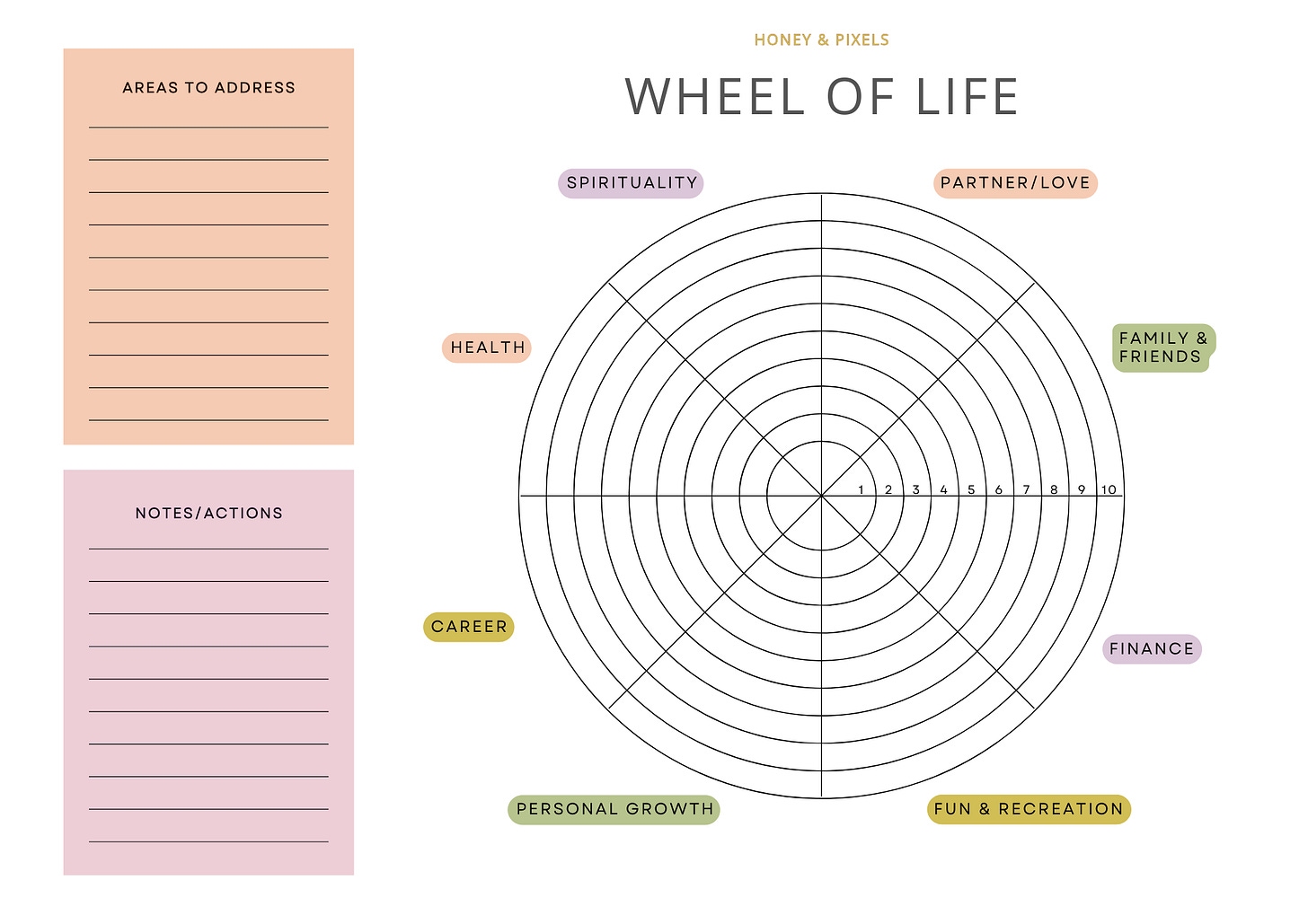
Before you fill this out, let’s take a look at some key indicators or signs across these areas of life that may be telling you it’s a time for a reset.
Career/Work
Signs: Persistent dread of work, consistently working more than forty hours per week, chronic lateness, decreased productivity, frequent conflicts with colleagues, a feeling of stagnation, role or process confusion, a persistent sense of overwhelm, feeling like you can just never get back on track let alone ahead, or when work consistently drains your energy instead of providing fulfillment, it’s time to reassess.
Money & Finances
Signs: Financial anxiety, living paycheck to paycheck despite adequate income, accumulating unnecessary debt, neglecting savings, feeling a sense of helplessness regarding your financial situation, or when financial stress consistently impacts your well-being, it’s time to take control and reset your financial habits.
Health (Physical & Mental)
Signs: Unexplained fatigue, frequent illnesses, changes in sleep or appetite, increased irritability, persistent sadness or anxiety, neglecting exercise, or using unhealthy coping mechanisms, when your physical or mental health is consistently compromised, or when you receive a professional diagnosis or lab results outside of normal standards, it’s a clear signal to prioritize well-being.
Partner/Love Relationship
Signs: Decreased intimacy, frequent arguments, communication breakdowns, feeling emotionally distant, a sense of resentment, romantic curiosity about other people, or when the connection with your partner feels strained or lost, it’s time to refocus on the relationship.
Family & Friendships
Signs: Feeling isolated or lonely, neglecting social connections, experiencing frequent conflicts, feeling burdened by relationships, feeling a lack of emotional support, not having anyone to have meaningful conversations with, or when your social connections are a source of stress rather than support, it’s time to reset your social life.
Personal Growth
Signs: Feeling stagnant or unfulfilled, losing interest in hobbies, lacking motivation, feeling a sense of purposelessness, or when you feel a disconnect from your passions, it’s time to reignite your sense of purpose.
Fun/Recreation
Signs: Never having time for leisure activities, feeling constantly stressed or overwhelmed, losing your sense of humor, feeling like life is all work and no play, or when you consistently neglect activities that bring you joy, it’s time to prioritize fun and relaxation.
Spirituality
Signs: Existential dread, lack of wonder or awe, loss of faith or belief, feelings of hopelessness, lack of service to others, critical or judgmental attitude, unhealthy coping mechanisms, or when you notice inconsistent engagement in prayer, meditation, or other spiritual disciplines—or abandon them altogether—it’s probably time to get back into spiritual alignment.
General Signals That Something Is Off:
- A pervasive feeling of being “stuck” or unfulfilled.
- A sense of burnout or exhaustion.
- A desire for change or a feeling that something is missing.
- A feeling of being out of alignment with your values.
By paying attention to these signs and signals, you can proactively identify areas that need a reset and take steps to create a more balanced and fulfilling life. Remember, a reset is not a sign of weakness, but a sign of self-awareness and a commitment to personal well-being.
How to Reset: A Holistic Approach
First, you’ll need to determine which areas of your life need a reset. There are a couple of obvious areas for me, but when I stop and consider all the various areas of my life, I can see there are few others that could use some attention. But how do we actually do it? Start by printing out either this or another version of the Wheel of Life and rating the quality of each of the areas from 1 to 10, place a dot on the coordinating line, and connect the dots when you’re done. Then let’s look into each area and consider how to initiate a reset. You may be surprised: Sometimes a little intention can go a long way. Just consider how each area is going overall and provide an honest assessment. (Be sure to rate according to your own personal standards.)
So, grab a fresh cuppa, pull out your favorite pen along with a printout of the chart below or a notebook with each category listed, put on your favorite playlist, take a deep breath, and focus on each of these areas below. The whole exercise should take you about 15 to 30 minutes, depending on how deep you go with it.
1. Career/Work
- Assessment:
- Are you feeling fulfilled and challenged?
- Do you feel valued and appreciated?
- Is your work aligned with your values and long-term goals?
- Are you experiencing burnout or excessive stress?
- Reset ideas:
- Set clear boundaries between work and personal life.
- Explore opportunities for professional development or learning new skills.
- Re-evaluate your career path and consider alternative options.
- Delegate tasks or seek support to reduce workload.
- If possible, take time off to recharge.
2. Finances
- Assessment:
- Are you managing your finances effectively?
- Do you have a clear understanding of your income and expenses?
- Are you saving for the future and managing debt?
- Are your financial habits causing you stress?
- Are you on track for retirement?
- Reset ideas:
- Create a budget and track your spending.
- Develop a savings plan and set financial goals.
- Seek professional financial advice if needed.
- Reduce unnecessary spending.
- Consider contributing more to a retirement fund.
3. Health (Physical & Mental)
- Assessment:
- Are you prioritizing your physical and mental well-being?
- Are you getting enough sleep, exercise, and healthy nutrition?
- Are you managing stress effectively?
- Are you dealing with any unaddressed physical or mental health concerns?
- Reset ideas:
- Establish a consistent sleep schedule.
- Incorporate regular exercise into your routine.
- Adopt a healthy eating, hydration, and supplement plan.
- Practice stress-reduction techniques like meditation or yoga.
- Seek professional help for physical and mental health concerns.
4. Partner/Love Relationship
- Assessment:
- Are you feeling connected and supported in your relationship?
- Are you communicating effectively with your partner?
- Are you spending quality time together?
- Are there unresolved conflicts?
- Reset ideas:
- Schedule regular date nights or quality time together.
- Practice active listening and open communication.
- Seek couples counseling if needed.
- Reaffirm your love and appreciation for each other in ways that are meaningful for the two of you.
5. Family & Friendships
- Assessment:
- Are you maintaining meaningful connections with family and friends?
- Are you setting healthy boundaries in your relationships?
- Are you prioritizing quality time with loved ones?
- Are your relationships draining you or supporting you?
- Reset ideas:
- Schedule regular catch-ups or social activities.
- Express gratitude and appreciation for your loved ones.
- Set clear boundaries to protect your time and energy.
- Let go of unhealthy relationships.
6. Personal Growth
- Assessment:
- Are you continuously learning and growing?
- Are you pursuing your passions and interests?
- Are you setting and achieving personal goals?
- Reset ideas:
- Read books, take courses, or learn new skills.
- Engage in activities that bring you joy and fulfillment.
- Set realistic and achievable personal goals.
- Practice self-reflection and mindfulness.
7. Fun/Recreation
- Assessment:
- When was the last time you did something you loved?
- Are you making time for activities that bring you joy and relaxation?
- Are you allowing yourself to have fun and enjoy life?
- Do you feel that you have a good work life balance?
- Reset ideas:
- Schedule regular downtime and recreational activities.
- Explore new hobbies or interests.
- Prioritize activities that help you unwind and recharge.
- Learn to disconnect from technology.
8. Spiritual
- Assessment:
- Do you have a regular spiritual practice (e.g., meditation, prayer, reflection)?
- Do you feel connected to something larger than yourself?
- Do you experience feelings of gratitude and awe?
- Do you feel like your values are aligned with your actions?
- Do you feel like you have inner peace?
- Do you feel like you are compassionate towards other people?
- Do you feel like you forgive yourself, and others?
- Reset ideas:
- Take time each day to meditate, pray, or send blessings to loved ones.
- Recharge in nature or places of worship.
- Develop a gratitude practice.
How is your wheel looking? Does it look something like this?
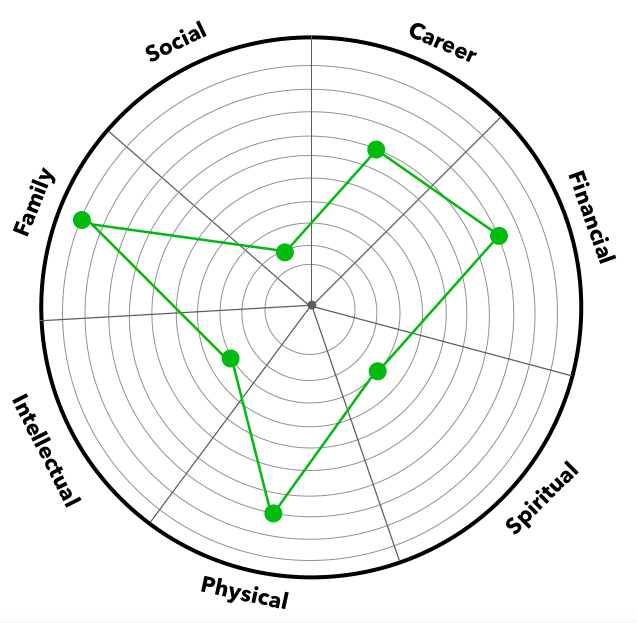
Example of a Wheel of Life from MINIMALISM Can you imagine riding a bicycle with this shape? Much like a real wheel, the Wheel of Life needs to be relatively balanced. You might be doing great in a few areas and not great in others, as shown above. Perhaps it’s human nature, but for me, I have a bad habit of investing more time and energy in those already-great areas and relationships while neglecting the not-so-great, causing some serious imbalance. My metaphorical bicycle wouldn’t make it past my driveway right now.
Unfortunately, that’s typically when something breaks and we’re suddenly forced to deal with this something in crisis mode instead of proactively handling things on our own terms in our own time.
By assessing each area of the Wheel of Life, you can identify areas that require attention and develop a personalized reset plan that works for you. A reset is not about creating perfection and getting perfect tens across the board, but about creating a more balanced and fulfilling life according to your terms.
How I’m Personally Navigating These Times
I won’t go into all the sticky details of my own life, but here are some of the things I’ve done in the last few weeks to begin addressing some of the areas needing attention:
- Spent a full Saturday (once I had one free) and overhauled my closet and dresser, putting together a capsule wardrobe that has been surprisingly enjoyable to work with.
- Continued simplifying and gathered several bags and boxes worth of donations to drop off. (For me, clutter=noise and I need clean, clear space to think clearly.)
- Began making a home project list of all the little things that need attention. Like that screw in the ceiling vent that’s been loose for three years.
- Made an appointment with a therapist to help me process grief, loss, anxiety, and stress—and to help me navigate whatever unrest our nation may be facing.
- Began meditating again—and more often. (I’m a longtime fan of InsightTimer in case you’re looking for a free app to use.)
- Began food tracking again. (This one is admittedly upsetting. I don’t want to do it, but I currently can’t be trusted to visually gauge calorie content. Thankfully, MyFitnessPal makes it easy.)
- Met some lovely new neighbors and started a monthly book club that will begin meeting at our house in a couple of weeks. (More on this soon.)
- Faced a professional crossroads and made a choice that I’m enthusiastically living into. (Grammar note: Did you know crossroads is plural in form but singular or plural in construction?)
- Started leaning in to executive presence at work, inspired by the book of the same name.
- Gave myself a break from creating and writing to rest and realign in order to have something to offer again. (Pssst! It’s okay if you do too.)
“The Great Reset,” whether it proves to be a global phenomenon or simply a deeply personal journey, is ultimately an invitation. An invitation to pause, to reflect, and to intentionally rebuild. It’s a reminder that even amid the chaos and uncertainty of life, we possess the capacity for renewal. By embracing the opportunity to recalibrate, to align our actions with our values, and to nurture our inner selves, we can emerge from these transitions not merely as survivors, but as architects of a more meaningful and fulfilling existence. Let us approach this reset with courage, compassion, and a quiet determination to cultivate a life that resonates with our deepest truths.
Thank you for being here.
-
Two Weeks in Hell: Spiritual Lessons From the Green Beret Training Camp
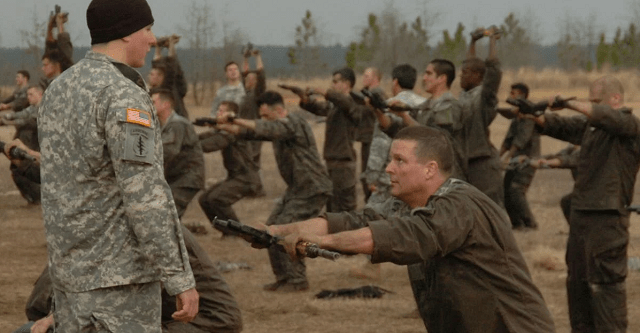
Remarkable lessons in our spiritual walk with Christ, in this life can be gained from the Green Beret’s training program. Discovery Channel aired a documentary showing the rigorous qualification testing volunteers must endure in order to prove themselves fit for the famous Green Beret Armed Forces group. They must prove themselves:
• physically fit,
• psychologically able to endure enormous physical demands; however,
• Integrity: able to carry out their mission alone or in a team as instructed when no one is watching,
• a spiritual component shows itself to be a vital quality,to most recruits who successfully qualify for the grueling two week ordeal where they are either accepted or rejected for the privilege to continue into Green Beret course training.
Many recruits did not last the first several hours or even the first day. They had a choice of voluntary exit the program or get eliminated. They operated sleep deprived to simulate the battlefield in this test environment with a few hours of sleep; they were called into action at any time of the day or night. Those who were over-confident or even arrogant were quickly eliminated since they had no idea of the difficulty of the program they were about to endure.
• The Green Beret’s Motto: “To Liberate the Oppressed”
To follow formal reason, the achievement of the above motto requires a personal sense of Apriori mission in the soldier’s heart. It must require a sense of non judgmental thinking as if they “deserved it” somehow, but focusing on the tyrannical injustice to the victim of those circumstances inflicted upon those victims, far above their ability to liberate themselves.
That sense of mission resides in us by that sense of “eternity” planted in our hearts as described in the book of Ecclesiastes and Augustine, to inherently know good and evil on the same standard as our Creator-God, Yahweh who says, “I am the Lord; I change not”.
I fail to see how a non-believer could follow that sense of mission, since his foundation is set on his own subjective sense of good and evil which may change from day to day, week to week or whatever situation he may find himself, a subjective shifting-sand type of right and wrong that is so prevalent in our society as God hating entities continue to ram their Godless agenda down the throats of those who believe through fallacy filled legislation, Constitutional error and Judicial decisions by judges who appoint themselves as legislators, ultimately resulting in the violation of everyone’s First Amendment Rights on a defective premise our God fearing forefathers never intended. A soldier on a shifting- sand faulty foundation could never achieve this mission To Liberate the Oppressed.
Two Weeks: Two Parts – Solo Performance And Team Performance
Week One focused on solo performance. They were taken out into the training environment wilderness in the middle of the night with only rudimentary direction finding equipment – a map and a compass. They were specifically instructed to avoid high traffic routes where they could be ambushed or spotted in a battlefield environment, especially traffic route bottlenecks where the enemy would spot them.
Their route finding required them to cross swamps, trackless wilderness without trail, high risk to parasites and other wild beasts, while avoiding the easier traffic routes as they were instructed, all during the middle of the night.
Although they carried flashlights, they were instructed not to use them since the enemy in a battlefield environment would spot them miles away and reveal their location. They were also given packs weighing 50 to 100 pounds. Should they be caught using a flashlight, it would be cause to immediately expel them from the course.
Vertigo: rolling
Volunteers training included rolling on the ground for long periods of time. The rolling induced vertigo and dizziness where many volunteers got dizzy and vomited. They were instructed not to vomit on the course but rather outside the area. Many got quite sick; some could not continue since they were both sick and disoriented. Not continuing meant they were out of the program. Many were eliminated in this step, which was only in the first day or so.Climbing
Volunteers were required to climb rope ladders, walls and log devices up to about 50 feet high. Some volunteers were not originally afraid of heights; yet, having gotten up high without any safety net caused some volunteers to freeze and had difficulty getting down. Delays in getting down meant they were scrutinized for possibly getting ejected from the program, depending on how they did in that situation.Heights
Some who were previously not afraid of heights because a bit freaked out when thy discovered they were 50 feet in the air with no safety rope or net. Numerous obstacles in the course included poles, walls and other obstacles the volunteers were required to scale quickly.Integrity: Following Orders
The definition of integrity has been described as to whether or not a person does what is right whether or not anyone sees them. In this rigorous program, the volunteers were taken out into the middle of the wilderness, dropped off and given a destination with a time limit to arrive at. They were unaware that the program Officers were observing them using night vision equipment (FLIR), which revealed the activity of the volunteer as if it were noon day. Those that were observed to be using flashlights, sleeping or failing to follow orders were eliminated immediately.The volunteers were also required to wear Geo-location GPS satellite navigation equipment to monitor their location for safety and monitoring reasons. Some recruits were caught sleeping, some were lost, some lost their sense of direction and did not arrive at their required destination either in the time limit or failed to arrive at all. Both were eliminated. By the end of the first day approximately 50 out of the 250 were eliminated.
Those volunteers who were observed to take the high traffic routes were eliminated immediately. Those routes bottlenecked the volunteers into areas where the enemy could easily ambush them. Although other routes were far more difficult including snake or wild beast infested swamps, deep waters, they were required to take those routes which avoided ambush.
Preparation
The video showed some volunteers were poorly prepared physically. Upper body strength was lacking to the extent that some volunteers were in such poor shape that they could not finish their mission. Muscles were obviously flabby, big bellies and soft arms like the Pillsbury doughboy.The Source of Orders
The volunteers orders came only from one source: a white board posted in the middle of camp. Orders were changed and executed any time of the night or day; volunteers were expected to execute them immediately with no delay. Delayed execution of the orders was reason for expulsion.Team Performance.
Week one focused on individual performance, obedience and personal resolve to execute their mission quickly and efficiently, to simulate the battlefield. In week two, volunteers were placed in groups of 10 – 20.They were given orders to move a 400 pound, 50 gallon drum of liquid about 7 miles. They were only given 4 poles, several wheels and some ropes. Each team appointed a leader; afterwards they devised a plan to use the poles, wheels and ropes in a makeshift system to move the barrel.
The most efficient teams took their system, filled in for those parts that lacked such as wheels falling off the poles, balancing the drum or whatever. They made their mission in good time.
Some teams lacked good leadership. Their system was poorly designed, causing excessive failures and ultimately low morale. Some gave up and just laid down by the side of the road from exhaustion and hunger. Several men had left their weapon behind and had to backtrack several miles to get it. Not to have a weapon was grounds for immediate expulsion. Inefficient teams argued and engaged in excessive discussion while the other teams worked together, filled their part and made the system work in a way where each man filled a need.
A critical function causing several teams to fail their mission was a lack of navigational skills. Their navigator failed to read the map correctly causing their team to take the wrong road, wasting valuable time in a hard lesson where they were required to move the barrel back several miles to the correct road, expending valuable time and energy.
Eventually, the last team arrived approximately 6 – 8 hours after the first, but long after the deadline had passed to fulfill their mission.
Lessons we can Learn
Personal Integrity v. Self Assured Destruction – S.A.D.
This author finds the lessons we can learn in our daily life, spiritual life, business life remarkable and long lasting. We as Christians are given a mission to “Liberate the oppressed.” We can’t liberate the oppressed until we ourselves are liberated. We liberate ourselves beginning in the times we are alone, when it seems no one is watching, as those volunteers found themselves in the middle of the night, in the middle of the wilderness, with only basic provisions for direction finding and given a mission to complete in limited time. Most failures were self inflicted; therefore, I will coin an acronym: SAD – Self Assured Destruction.Arrogance and Pride
The first device for SAD is pride and arrogance. Regardless of how well even the few prepared, even the most confident were shaken by the difficulty of the course. Life brings us curve balls, ambushes and unexpected grief many times from our own shortcomings or something we have no control over. Those who successfully endured to the end reaped the prize; the prize and honor of the Green Beret; a heritage to be passed down through the generations of the family and nation. Those who were self absorbed in the glory of their own abilities found themselves SADly mistaken.Disoriented in the Dark
Like those volunteers, we find ourselves in life seemingly dropped off in the middle of the night, we don’t know where we are and have few resources, save a map which is our Word of God. Self pity would be our second device for SAD.If we sit down and wait until things are better, like those who hid themselves in a field, covered themselves until daylight, failed their mission, their fellow soldiers and their own integrity. We don’t have forever. The Psalmist says, “teach me to number my days.”
Alone in the dark, secrecy gives us a false sense of our ability to “get away with something”, to cheat the system. What those volunteers failed to know or remember is that their supervising officers were watching their every move, even though it was pitch black in the middle of the night, through their night vision glasses (Infra Red FLIR).
Their every move was being observed through the night vision binoculars, just as God watches us as well. God will hold us accountable for every SAD device we engage in. Jesus said, “What is done in secret will be shouted from the housetop.” Let’s remember to do good things in secret, when no one watches, save God, so those things shouted from the housetop will be a pleasant return of honor, rather than shame and humiliation.
24 Can anyone hide from me in a secret place? Am I not everywhere in all the heavens and earth?” says the Lord.
Jer 23:24 (NLT)Taking Shortcuts: Another device for S.A.D.
Those volunteers were monitored by GPS – satellite; their every move was known, just as God watches us from his Eye in the sky. If we were outside of His knowing, He would cease to be God. They were instructed not to take routes which led them into a closed area, limited for escape, even though it was a shorter and easier route, where the enemy could ambush them.
Their alternative (and instruction) was to take those paths which assured their safe arrival, if necessary cross swamps, through snake or other hostile environments with their heavy 50 pound or more packs and weapons. Those volunteers who took the short cut were eliminated.Just as Jesus said, 13 ” Enter by the narrow gate; for the gate is wide, and the way is broad that leads to destruction, and many are those who enter by it. 14 “For the gate is small, and the way is narrow that leads to life, and few are those who find it.
Matt 7:13-14 (NASB77)
Although us as Christians may not lose our salvation by taking the easy path; that license for grace cannot be assured since it is God who judges. For the volunteers, the easy path was another device for S.A.D and ejection from the program. Officers intercepted those even in the middle of the night when it was most unexpected, who took the easy path and eliminated them from the program.Teamwork
The physical, moral, spiritual character and ability of those volunteers shown brightly when teamwork became essential. Leadership qualities each of them demonstrated as a requirement during the 400 pound barrel mission where navigation, map reading and direction finding became essential to complete the mission on time and on course.As is in our Christian walk, our direction is not subjective, subject to the shifting sands of our whims, moods or societies ever changing standard. Our directives are given to us by our Commander Jesus Christ, they do not change and neither does He. His truths are Apriori- they are true in all times and all places. His truths and Word is a Lamp to our feet and a light to our eye even when it’s dark outside, there is no one around and we don’t know where to go; we can depend on the light of His Word and Spirit to guide us.
When those Volunteers were dropped off in the middle of the night, it appeared they were alone; we too seem like in life’s situation no one is around to help, talk to or guide us; but the Holy Spirit is God’s down payment of the promise He has given us that He will always be with us and never forsake us.
Those Volunteers, when in a team, had no room for ego or arrogance when they were focusing on their mission; neither do we have room for ego or arrogance to accomplish that mission (or purpose) God has given us. The ability to work with other believers is essential to accomplish those purposes.
The timing of the mission also determines a mission successful or a mission failed. Martin Luther King said, “Justice delayed is Justice denied.” If we delay the Justice of God’s directive, we are an accomplice to rebellion. To those Volunteers, bringing in that 400 pound barrel 8 hours behind scheduled mission was a failed mission. To those Volunteers that failure happened by, A) Lack of leadership, B) Lack of direction or navigation, C) Lack of Unity (or ego), D)Lack of preparation (lack of physical, moral or Spiritual strength.
The ability for each team to prevail or transcend their difficult mission, was determined by the ability of each Volunteer to prevail in each person’s Spirit, Soul and body; to focus on the prize of the glory of a mission accomplished and a job well done when they operated days or weeks sleep deprived, hungry, exhausted, doubting their abilities; but their strength of character; self talk must prevail against those inner voices screaming out JUST QUIT!
When David was at Ziklag, he found his wives and children taken captive, his village was burned, his men ready to stone him and Saul was still after him, but David encouraged himself – he made a deliberate choice for encouraging self talk, not to listen to those internal or external voices screaming for our defeat, but he remembered how God had been faithful to provide, protect and meet his every need. When he humbled himself, asking God’s direction; God directed him to go and recover his wives, children and goods. David executed that directive with all of his might like those Volunteers; David did not sleep until his mission was fully accomplished; he continued all night pursuing his enemies… to “liberate the oppressed.”
Our self talk also determines what outcome we will have as well. Like the spies who spied out the promised land; they prophesied their own victory or defeat. Those who said “we are like grasshoppers” were defeated and died in shame in the desert exactly like they professed in their fears. Those who professed they could take the land did exactly that; they went forward and took the land. They watered the Word with faith, on the Word they received from their God who promised them victory. They chose courage, faith and reaped a harvest of honor and victory, ultimately demonstrating the eternal strength of their God in the face of overwhelming circumstances where their enemies were bigger, stronger and were on their home turf.
Summary
It is the opinion of this author that those Volunteers for the Green Beret’s have much to teach us if we stop, look, listen and acknowledge their dedication, strength of character and integrity they demonstrated while in the middle of the dark wilderness, crossing swamps, bearing enormous physical burdens, bearing up alone or with others, while given strict time constraints, sometimes disoriented, puking and exhausted. Prevailing against those burdens require a strength of spirit that prevails over those without a sense of the eternal good and evil. I say it is our forefather’s character in the WWII generation that sometimes overshadows ours.In contrast we see our societies icons of fame, wealth and power falling like dominoes in shame and humiliation by moral failings where they forgot their fear of God while, dirty deeds done dirt cheap while they were in secret, forgetting that God will shout their unfaithful deeds from the housetop. Many athletes, corporate executives’ fortunes and honor have ended up in divorce court, prison, dishonor or all of the above.
We got it wrong. Our icon’s of the latter are a paper moon of self, immediate gratification. Our real icons we have overlooked are those men and women, who like those who Volunteer for the Green Beret’s, may never be known for fame or fortune; yet, their Apriori strength of character is what gives those iconic failures the opportunity to fail. We as Christians should learn from them.
Let this article honor the demonstrated character of those Green Beret’s… and let us learn from them.
-
The Scourge of Hegemon USA- If nations had personhood, hegemon USA would be diagnosed as psychopathic, sociopathic and pure evil.

Biden regime dark forces pressured, bribed and bullied 12 UN Security Council nations to abstain from blaming hegemon USA for destroying 3 of 4 Russian Nord Stream II gas pipelines to Germany.
The empire of lies is infamous for policies detrimental to the lives and well-being of the vast majority of people worldwide.
At war on nonthreatening Russia for nearly a decade, hegemon USA may destroy planet earth and all its life forms by its megalomaniacal rage for unchallenged control.
As long as it exists in its present form under either wing of its war party, the state of the nation is jeopardized and world peace is off the table.
As long as other Western regimes bend to the will of a higher US power, Russia, China and other independent nations will continue growing in prominence at the expense of the decadent, depraved West.
If nations had personhood, hegemon USA would be diagnosed as psychopathic, sociopathic and pure evil.
Its ruling regimes are demagogic, egocentric, cold-hearted, manipulative, ruthless, remorseless, callous, shallow, impulsive, ego-centric, dishonest, deceitful, dangerous, depraved and deranged by threatening everyone everywhere in pursuit of their rage to dominate by whatever it takes to achieve their aims.
A nation nominally led by a know-nothing mumbling, bumbling, stumbling White House imposter is a clear sign of a decadent, depraved society in decline.
Its ruling regimes blame other nations for crimes committed against them by the empire of lies.
The nation I grew up in long ago is unsafe and unfit to live in for the vast majority of its people — ruthlessly exploited, not served.
On December 6th President Trump’s words shook the world.
For the first time in over 2000 years, Jerusalem was recognized as the capital of Israel.
Whether he knows it or not, President Trump fulfilled his part in a frightening biblical prophecy exactly as the scriptures predicted.
Only the top church leaders and Bible scholars know the real meaning behind this great and terrible moment, yet no one is saying a thing about it…
So pay chose attention because this video will change your life forever for the good!

-
German Press Discusses Pfizer Vaccine Trial Fraud. Will “Covid Reckoning” Follow?

German Press Discusses Pfizer Vaccine Trial Fraud. Will “Covid Reckoning” Follow?
“Pfizer fraud” now openly discussed in mainstream national press
I am pleasantly surprised to see the mainstream German publication Die Welt openly asserting that clinical trials of the “Pfizer COVID vaccine” were rife with fraud.

The article explains that Pfizer unblinded and removed numerous patients who suffered adverse events from the Covid vaccine trial. It also gives examples of Pfizer subjects whose deaths were covered up. One of the victims described by Die Welt is Pfizer subject C4591001 1162 11621327, whose story I unearthed in July of 2022.
WELT has documents according to which patient no. 11621327 was found dead in his apartment three days after the 2nd dose, apparently a stroke. Patient #11521497 died 20 days after vaccination, diagnosis of cardiac arrest. “According to the current state of science, these two cases would be assigned to the vaccination,” says the Berlin pharmaceutical specialist Susanne Wagner, “especially since the US health authority CDC is currently investigating strokes in vaccinated people and it is known
As you remember, Pfizer’s investigators falsely ruled these deaths unrelated.
Die Welt also describes Argentine lawyer Augusto Roux, who remained alive, but whose sufferings were written off as “anxiety.”
Three weeks later, test candidate Roux received the second dose. He remained under observation for 40 minutes, then left the hospital feeling good. In the taxi home he felt uncomfortable, and later he had shortness of breath, burning chest pain, nausea and fever. His urine turned black like cola and he passed out. Three days later, Roux was in the Alemán Hospital, several PCR tests for Covid were negative. Senior physician Gisela di Stilio noted in the discharge report, which is available to WELT: “Adverse reaction to the coronavirus vaccine (high probability)”. The computer tomograph had provided images of fluid in Roux’s heart. A pericardial effusion.
Over the next few months, Roux lost 14 kilos, he had liver problems, and his heart sometimes beat irregularly. … The diagnosis for the symptoms after the second vaccination is very likely to be “pericarditis”, inflammation of the heart. All of this fits exactly with a clinical picture that the Paul Ehrlich Institute also has in its list of “rare side effects” for mRNA vaccines.
Note how Die Welt sarcastically puts “rare side events” in quotes.
… He found amazing things there. His story, one might think, should appear in Pfizer’s pivotal study papers, but it doesn’t. The pharmaceutical company’s papers say Roux informed the research team that he was hospitalized with pneumonia on both sides, following the initial report, which was classified as an “adverse event of toxicity level 1”. That could have nothing to do with the vaccine, the file goes on to say, it is probably a Covid infection. Not a word that Roux had tested negative for Corona in several PCR tests.
The paper finds more cases of Pfizer fraud:
Almost at the same time as the Roux case, there must have been an incident in the Buenos Aires test center. In one fell swoop, the test management said goodbye to 53 subjects on August 31, 2020. The test candidates were “unblinded”, which means they were informed about their vaccination status, a process that the Pfizer study protocol expressly only provides for “in emergencies”. But there is nothing about it in the approval study. In protocol documents that are available to WELT, and which are actually not intended for the public, those responsible get caught up in contradictions. “
Pfizer Fraud Discussed in Mainstream Press
While Die Welt does an excellent job at exposing Pfizer’s trial fraud, which the FDA wanted to hide for 75 years, most of what it discussed is not new to us. What is new is that mainstream newspapers are now discussing it.
Die Welt mentions that Pfizer’s contracts included a liability waiver even for Pfizer’s negligence and for “fraud or bad faith on the part of Pfizer itself.“
I expect this “fraud waiver” will be litigated furiously in many countries. In the United States, liability for certain misdeeds, such as fraud, cannot be waived in advance because it would “violate public policy” and encourage fraud. Thus, I expect Ed Dowd’s “fraud vitiates all contracts” doctrine to prevail legally in many localities.
A “General COVID Reckoning” Will Follow!
A question that many of us are asking is, “will there be trials?” A friend of this substack, Eugyppius, concludes with regret that “there will be no Corona reckoning in Germany.”
I am not an expert on German politics, but I would like to make a statement: in more than one country, though possibly not in Germany, there WILL be Corona reckoning. A mini-reckoning is already happening in Florida, which gives us a hint of the future. (ER: There is a possibility of this in Thailand)
The governor of Florida, Ron DeSantis, is a shrewd political operator who expects to benefit politically from defending the public from Covid vaccines.
I am optimistic that some reckoning and some punishments will happen. Consider this:
- Almost everyone was affected by Corona vaccinations. People were either vaccinated or discriminated against, with the extent of discrimination varying from country to country.
- Covid vaccination harmed a significant fraction of vaccine recipients. The harms are numerous. A Thailand study found 29% of young males having subclinical heart damage, for example. I discussed, numerous times, immune system damage affecting vaccinated people who suffer Covid reinfections and endless other illnesses.
- While many vaccinated individuals do not realize that Covid vaccines affected them, they can be easily convinced that they are vaccine victims when presented with evidence.
- Many vaccinated people had multiple COVID infections. If nudged, they will see the apparent disconnect between promises and the ugly reality.
- Lawsuits against Big Pharma, and possibly against Google and Facebook, will, naturally, make many people consider whether they are also victims when financial compensation becomes a possibility.
- People understandably fear death, and the excess mortality we are experiencing worldwide should unsettle any person whose risk of death is heightened in a mysterious, unknowable way.
- Many political operators will realize they can build a career by being anti-Covid-vaccine and demanding retributions. While this has the potential of turning ugly, it is an important factor.
- There is a possibility of mass hysteria created around “will the Covid vaccine kill me,” which the above-mentioned political operators can turn to their advantage.
The most important determinant of how much “Corona reckoning” we will see is the future fate of humanity and the disturbing trends of excess mortality and infertility.
I want these trends to reverse, and mortality and fertility to return to normal. Such a fortunate turn of events would necessitate only a moderately serious reckoning.
In the highly undesirable case of the general public’s health trends taking a turn for the worse, stricter punishments against people who lied to us and forced the public to take the deadly experimental vaccines would be perfectly acceptable.
National laws may need to be revised to allow legal punishment of wrongdoers who participated in a novel global biomedical crime that harmed billions of humans. In plenty of precedents, crimes against humanity committed under the color of national laws were successfully prosecuted.
So… do you think at least one country will see any “Corona reckoning”?
-
Cancer – My Old Story, Understanding The Cure!
Cancer! That is the name for it. It can bring many different unpleasant thoughts, but when you hear your Doctor say the word all of a sudden you are numb. All of a sudden you are the other guy. They must be mistaken. But no, you have it and it is real and “you” must decide what you will do about it.
In my case back in 1995, I was told I had three different kinds of terminal cancer. We had just buried my Father a few years before after a dreadful bout with cancer using the finest that modern medicine had to offer, we thought we had done our best for him but I watched him melt in pain and the most humiliation he had ever suffered in his lifetime from the radiation and chemo. A sarcoma was growing on my back, my lymph glands were cancerous and then an egg size tumor on my left kidney was found. My Doctors let the sarcoma get by them. I had kinked my neck and after three days of excruciating pain I freed it up with summer-salts; but at that spot almost right between my shoulders, a lump started to grow after about two months, they thought it was a lump of fat. It was later found to be a deadly sarcoma. My Doctor brought in specialists and they recommended I go to OHSP, in Portland Oregon for the major operation because they thought the roots had likely progressed into my spine.
The day before my operation my people had gathered in my brother-in-law’s motor home that he had brought to the parking lot of the hospital. We watched the 1995 Super Bowl; all vowing to meet every year there after with hugs and tears knowing full well that likelihood. As I realize now half of them younger than me have since past.
About one month earlier when we first suspected a problem my daughter had started me on something called Pycnogenol, from pine bark and grape seed. In the week prior to my operation my people brought me some Essiac Tea and some info from the Herbal Healer Academy called “The Calling of An Angel” by Doctor Gary Glumm.
When the Doctors went into my back they were surprised to see that the tumor had what they called “capsulated” the tumor was in a sack, no fingering roots like they feared. I believe maybe the sack indicated my resistance had overcome the sarcoma though it was as big as half a grapefruit.
In the recovery room the nurse was concerned when she was testing me, and said I had been away for a short time, but it looked like I had made it all the way back, “he he.” I was happy too and so thankful to God to be here but before they released me from OHSP an MRI showed an egg size tumor on my left kidney. The Doctors said that can be removed back home. I asked “the tumor or the kidney?” They chuckled and said “the kidney.”
The plan was after a few weeks of recovery I was to have the kidney removed and then begin a regiment of chemo. If everything went according to plan I should have at least a year and a half to live… That was 1996, today is December 2010, up-date Sept 21, 2011.
Do I think I am a smarty pants? I may sound that way because I am so confident in what I have discovered that I just can’t wait to tell people, but believe me I am so thankful to God for this extra time I just want to do “something good” for somebody? So please see my words as coming from a most humble soul.
I never took any chemo or radiation partly because of timing but mostly because I wanted to see if the tumor was indeed going to cost me my kidney. I got into the “Essiac Tea” in a strong way; I drank at least my 4oz. a day and “I tried to eat a better diet.” We watched the tumor shrink from eggs size to the size of a dime over a three month period with the ultra-sound thing. The problem with the lymph nodes disappeared and the Doctor declared me cancer free in late 1996 and I haven’t looked back since.
Today I am 73, I watch my blood pressure with a prescription capsule but I am healthy as a horse in most every way except I’m not quite as fast as I was once. But let me tell you what I have found out…
Lately I have been more and more driven to tell people that you don’t have to die from cancer! I have told my story time and again but most folks just don’t understand that miracles really do exist. Folks sometimes are skeptical about the words of a common man, and if we are not rich or famous, then we don’t know or count. You will soon see that the strange things I tell you are true to the core and when linked together like connecting the dots they reveal secrets beyond all imagination.
I have realized that we are all 99.9% the same inside to a perfect blue print according to science. Now I know this is the hard one, it was for me; we look different because of our shape but on the inside the mechanism is all the same. That is what those biology books really meant to say. Throughout our lives we are told that we are an individual like no one else, so much so that we believe we are physically different. Trust me we all need the same things to survive; according to science we have over Three Billion parts. Wow, all working together in real time; how long does it take you to cuss when you stub your toe? Now that is a phenomenon.
Actually these little parts or cells are so small we must have a microscope to see them. And with our finest high-tech computerized scope science has discovered that inside each one of those tiny cells is a DNA ribbon that contains over Three Billion segments; one segment for each cell in our body. According to science it is in this tiny world inside each of our cells, this is where “all of our growth and all of our repair takes place, period.” Now that is something to think on. In a world this small what can we do to help that growth and repair?
I suppose our smallest high-tech instrument would probably work no better than a screw-driver and a pair of pliers.
We can only see the shadows of these tiny segments with our finest high-tech computerized microscope; these thing are tiny!So if we go to connect the dots of all the things that we know to be true… I mean forget everything what our commercial TV has told us for a lifetime and consider that we are greatly guided by public opinion and the politically correct. Man has survived many thousands of years, “without modern medicine.”
#1 we are all 99.9% the same to a perfect “blue print.”
#2 we all need the same things to survive.
#3 we were constructed from one tiny cell by a system that has built this masterpiece from the dust of the ground into over Three Billion cells that all work together in positive perfection. Only God could have done this and only His creation can do any repairing to itself. If we cut our finger, all of the salve and band aids and high-tech in the world cannot do “any” healing, if our own God given life system fails, we die, period!
#4 I love my Doctors and Nurses; they are real people dedicated to helping folks. But they are governed by the law of the congress to what they can do and say through the AMA and the insurance companies and even criminal charges.
#5 if we look into the tiny world that is the foundation of our existence realistically we have but three choices;
We can only damage those little segments physically.
We can poison them with the chemo and prescription Drugs and we can make them everyone sick, quick, or a third choice, we can feed them what they need to be the best they can be.#6 I believe it all comes down to the minerals, we are made of minerals, just like everything on this earth. Minerals are the dust of the earth, the 90 some elements. According to science we have all of them in the make up of our bodies, most of them in trace amounts except for the biggie, “calcium.” “Them Bones”, Calcium comes from deep in the ground where the roots of the alfalfa plant dig to find the water they so love. But the water is just the conveyor of the calcium and other wonderful minerals the plant uses to build it’s roots, stem, leaves and it’s everything so that a big old happy cow can chew it over and over again to process the milk, white, with calcium for our tummies, bones, joints, tendons, arteries and literally everything needing strength right down to our cell walls. Our entire life system requires a continual supply of fresh calcium forever, it is hard to assimilate and too often as we age we may not get enough. (apple cider vinegar helps)
#7 The logic of this concept is that if we are to realize that our food has the most influence on our development both physical and psychological then we can easily see the answer is in the minerals. We all need the same variety no matter what we are facing; in order to maintain we need to supply our system with what it needs to be its best. Herbs are food, they contain concentrates of minerals and through the years Man has found certain Herbs to be quite beneficial. One we know that is surely the best known world-wide and approved by nearly every experienced Doctor; is “White Willow Bark” or Aspirin.
I know we may have a hard time relating our situation to this concept, but maybe no matter what the problem, broken leg or brain tumor it is only our own God given system that can heal and we must take care of that system…
I have put everything that I believe into one thing and I call it “Easyak Kookies”… In my travels I have discovered a long history of an Herbal Formula learned from an old Ojibwa Indian Medicine Man back in the 1920s. It is called today “Essiac Tea” thanks to a wonderful nurse named “Rene Caisse.” (last name spelled backwards) You can find most of that history on the web under those names. The non-commercial history will tell of miraculous recoveries by patients that had been rejected as hopeless. The Amish People believe it is an absolute cure-all…Herbal Healer Academy.com
Today I am out again trying to spread the word that you can survive cancer, and many other body born conditions with just the understanding of why and how we get here. I believe it is the minerals that we need, and the exercise to properly assimilate them, but most of all it is the resolve and the focus in the right direction.
If you believe you will try harder to learn and do what you know you need. I think;
1 we need to get clean inside with a “Candida Cleanse” maybe.
2 drink too much water, stay soft and moving.
3 get on the minerals Milk, Slim-fast, Ensure, Essiac Tea, Easyak Kookies, fish, improve your diet, get slim if you are not (intake/output)
4 apple cider vinegar, (capsule, pill), more veggies, fruits, juices. An aspirin a day.5 the most important part is you. Try some music and make some moves. You must know that God meant for you to be the best you can be for as long as you can and that He is in your heart as in mine to help in any way He can.
Teddy Daw The Medicine Man
To me the most important thing I want to stress, it would be that you are not alone. You are not the first to have this slap in the face called cancer. It is what you do from here, or what you will do if cancer ever comes. Remember God made us all the same way inside, we all have the same parts even though they may have shifted a bit because of our flexible flesh, but we all need the same things to survive, period!
I know the hardest thing in the world is to believe that there is “anything” outside the Modern Professional Medical Opinion, and they are probably fairly accurate; in 1995 they gave me the short side of a year and a half if I followed their plans for me. I didn’t, I revived my natural resistance with Herbs, “Essiac Tea” and a change of mind.
-
Death by Kill Shot- The fake Biden earlier trampled on truth by falsely calling kill shots “safe,” adding: “I promise you, they are safe and effective.”

How many casualties are too many from jabs designed to destroy health on the phony pretext of protecting and preserving it?
Since seasonal flu got a scary new name, followed by mass-jabbing, we’ve been lied to and mass deceived by US/Western dark forces and their MSM press agents.
The fake Biden earlier trampled on truth by falsely calling kill shots “safe (sic),” adding:
“I promise you, they are safe and effective (sic).”
Countless millions of casualties exposed the Big Lie.
Yet the Biden regime once again extended a flu/covid public health emergency, invented to justify what’s unjustifiable.
The only real emergency was caused by toxic kill shots, irreparably harming everyone jabbed.
Yet White House kill shot coordinator, Ashish Jha, continues to cover up and deny what’s indisputable by pushing forever-jabbing.
Kill shots are working as planned.
Reality about what’s going on got emergency physician, Joseph Fraiman MD, to publicly call for an immediate halt to mass-jabbing because indisputable evidence revealed “serious harm” they cause, saying the following:
They’re “associated with…serious adverse events.”
“But the FDA failed to inform the public of these findings.”
“In addition, we have multiple autopsy studies that find essentially conclusive evidence that (jabs) are inducing sudden cardiac deaths.”
Nations administering mRNA, DNA-altering, jabs “experienced an increase in excess mortality.”
“More people dying than should be expected from past years.”
“And this correlates in time with the initial (kill shot) rollout, and then with the subsequent booster campaigns.”
“Nations with higher messenger RNA (jabbing) have correlations with higher rates of excess mortality.”
Yet according to the fabricated official narrative, “benefits of (jabs) outweigh the risks (sic).”
Indisputable evidence proves otherwise.
Noting peer-reviewed research on Pfizer and Moderna kill shots, Fraiman minced no words, stressing that “conclusive evidence” of their health-destroying harm.
GOP Senator Ron Johnson is a rare exception to the rule on flu/covid mass-jabbing, earlier saying:
“No one should be shamed, coerced, or mandated to take” flu/covid jabs.
“Since there is little to no benefit for me getting (jabbed), I decided not to.”
“Absent proven benefit or medical necessity, there is only risk.”
“There should be nothing controversial about me or anyone else making a similarly informed decision.”
On January 10, he demanded that chief medical fraudster for the Pharma-controlled CDC, Rochelle Walensky, explain why the agency reported no “unexpected safety signals” from kill shots despite indisputable evidence of their health-destroying harm, stressing:
“Given ‘hundreds of (known) adverse events,’ the CDC must explain how it determined what is and is not an ‘unexpected safety signal.’ ”
“The American people have a right to know the extent to which (the) agency was aware of and tracked (mass-jabbing) adverse events.”
And he slammed the agency’s “lack of transparency,” calling it “unacceptable,” adding:
“Without immediately providing complete and reliable information about adverse events (from jabs), you are obstructing congressional oversight and leaving the public in the dark.”
Johnson gave Walensky a Jan. 17 deadline to “provide a full response to this letter and to requests in my June 23, July 25, and September 12, 2022 letters.”
She’s been concealing truth and full disclosure by stonewalling Johnson’s requests.
Separately, researcher Alexandra Latypova stressed that the public was deceived, saying:
Flu/covid jabs “are biowarfare agents, legally not medicines, not pharmaceuticals, and not regulated as such.”
US/Western regimes are complicit in “mass genocide” of their unsuspecting people.
So-called “other transaction authority (let US) agencies (and their Western counterparts) bypass otherwise-regulated products.”
And they provided “legal protections to vendors by ordering a “fake theatrical performance from the pharmaceutical manufacturers” adding:
“Contracts include removal of all liability for the manufacturers and any contractors along the supply and distribution chain under the 2005 PREP Act and related federal legislation.”
Flu/covid jabs OK’d by Emergency Use Authorization (EUA) when no emergency existed “were not required to comply with US law governing manufacturing quality, testing, effectiveness, safety, and labeling.”
Even as mass-casualties mounted, there was coverup and denial instead of revelation of reality and action to halt what’s destroying public health.
“The implication is that the (hegemon USA) authorized and funded the deployment of noncompliant biological materials on Americans without clarifying their ‘prototype’ legal status.”
And while “making materials not subject to normal regulatory oversight, (the public was willfully deceived by) “a fraudulent pseudo- ‘regulatory’ presentation,” Latypova explained.
Separately according to peer-reviewed research published on January 5 in the European Journal of Pediatrics, 17% of high school students experienced heart problems from flu/covid jabs —based on ECG results.
Symptoms include palpitations, chest pain, shortness of breath, and dizziness or fainting.
Study findings confirm results of other research.
Flu/covid mass-jabbing causes heart and other health problems.
A separate study in Thailand found adverse cardiovascular issues in 29.24% of individuals studied — including tachycardia, palpitation and myopericarditis (inflammation in two parts of the heart).
From March 2021 – March 2022 alone, over 700 athletes, aged-23 on average, collapsed while participating in their sport.
And recently revealed Pfizer video evidence indicated risk of myocarditis from the company’s nRNA jabs.
Mounting evidence shows what’s indisputable.
Flu/covid jabs destroy health instead of the other way around as officially claimed and pushed by MSM press agents for the most diabolical scheme of all-time.
A Final Comment
Air Force football player, Hunter Brown, aged-21, is one among countless numbers of death by kill shot(s), Dr. Paul Alexander reported on January 11, saying:
He “collapsed and died while walking to class today.”
In coverup and denial mode, the Air Force Academy dismissively said that he suffered a medical emergency.
An attempt to save him was unsuccessful.
Buffalo Bills player, Dumar Hamlin, was saved from certain death from one or more kill shots, causing cardiac arrest, by immediately administered CPR on the field, followed by swift hospitalization.
Hunter Brown wasn’t as fortunate.
Nor were countless other victims of kill shots.
-
Economic collapse = societal collapse. It’s deliberate so that we can have “order out of chaos”, as in New World Order, also known as the tyranny of the ruling sociopaths.
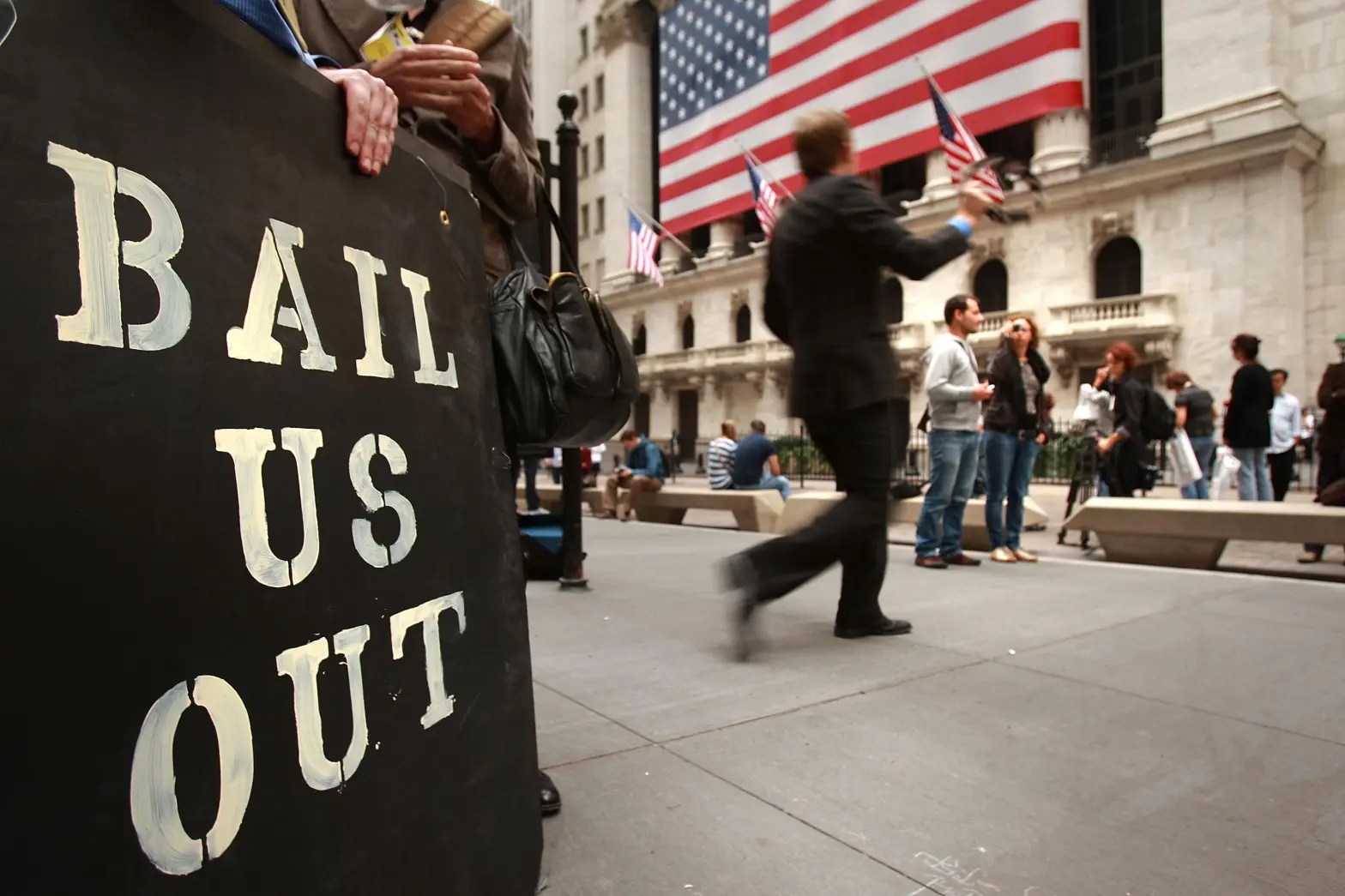
Other than the obvious consequences, what might we expect from a partial economic collapse? A total collapse of the economy would throw the nation into utter chaos. But what if we endure an economic depression, or a severe and long-lasting downturn? I think that some of the effects are not so obvious.
1. The college and university system will collapse
As I explained in this previous post, the system of higher education is a house of cards. The cost of getting a college degree has risen sharply and steadily, while real income has remained relatively flat. The price rise is due to the easy availability of grants and loans for education. But with so many persons getting a college degree, its value in the marketplace has plummeted. Many college grads are out of work, or they are working in a job that does not require a degree. Eventually, this practice of paying more and more, for something that is worth less and less, will collapse the system. Colleges and universities will not have enough paying students, and professors will not agree to a drastic pay cut. Overhead expenses are far too high.
All that is needed is an economic collapse, or partial collapse, to topple this house of cards. Many universities and colleges will be forced by economics to shut down.
2. Agricultural yields will plummet
The current U.S. agricultural system is based on the expectation of high yields. But high yields are obtained by high inputs — all the things that go into growing the crop, including lots of fertilizer, perhaps irrigation, herbicides, pesticides, labor, machinery. Then those high yields are sold and the money is then used to fund the inputs for the next crop cycle.
An economic collapse will mean that farmers will not be able to afford all the inputs needed for high yields. And when yields fall, the amount of money from that crop will be less. Then the next crop cycle will have even less money for inputs, resulting in even lower yields. And the process will continue — lower yields, less money, lower inputs — until many farmers are out of business and a food crisis results.
3. Violent crime will increase
When people lack money and food, they become desperate. And desperate people do desperate things. Theft and robbery will skyrocket, and people will be afraid in their homes, and afraid to go out in the community. Even a quick trip to the market will become risky. Sales of most goods will plummet, causing the economic crisis to worsen. Protests will turn violent. Home invasion robberies will become much more common. Many people will be killed or injured as a result of this increase in violent crimes.
4. Law enforcement will be overwhelmed
The law enforcement system in the U.S. is commercial. Officers are paid. We don’t keep a large excess of officers on the payroll, just in case crime sharply increases. So it is relatively easy for the system to be overwhelmed. And that means a call to 911 might not bring the police to your door in time, if at all. Those who have firearms for home defense will be much better off than those who rely solely on the police. But many households have no firearms. And that means that robberies will increase, and so will the economic damage and the number of injuries and deaths.
5. The healthcare system will be overwhelmed
The healthcare system is also commercial, and lacks a safety margin in the form of excess doctors and nurses. Hospitals operate at close to capacity. A sudden increase in persons who are sick or injured will overwhelm the system.
The aforementioned increase in violent crime will undoubtedly increase injuries. But it is less obvious that a disruption to the food production and distribution system will increase illnesses. Plenty of good healthy food is the first line of defense against illness. Malnourished persons are much more likely to get sick. So an extended disruption to the food supply will cause an increase in illnesses.
6. Travel anywhere will become dangerous
As a result of all the above described problems, travel will be dangerous. Want to make a quick trip to the supermarket? You risk having your house robbed, if it is left unoccupied. And you risk being attacked on your way back from the market. Robbers might wait outside the market and follow anyone who looks like they purchased a lot of food.
There will be protests in many places, and violence will often break out. People who are hungry and afraid do not make the best decisions. Then there is the cultural aspect of the situation. We live in a culture that tells us to expect the government to take care of us, and to protest whenever anything doesn’t go our way. Ironically, self-sufficiency is abhorrent to our narcissistic culture.
I expect that the roadways will be dangerous, as violent criminals will see travelers as easier targets than homes.
7. The death rate will jump higher
People will be malnourished because of the disruption in the food supply, so they will get sick more easily. Violent crimes and violent protests will result in many more injuries than usual. And yet healthcare will be much more difficult to access. There will be a shortage of hospital beds. It will be difficult to get a doctor’s appointment. There may be a shortage of prescription and OTC medications.
All of these factors will make life a riskier endeavor.
Now if you are a seasoned prepper, who has long considered the dangers inherent in an economic collapse, you may have anticipated some of the above consequences. But I hope I’ve added to your understanding of the possible problems that we may soon face.
-
Monstrous Miscarriage of Justice
On Wednesday, guaranteed speech, press and academic freedoms under the Constitution’s First Amendment suffered another significant body blow — en route to abolishing these most fundamental of all rights altogether in the US and West, based on the current trend.
After three days of deliberating phony charges against radio host/Infowars editor Alex Jones, a mind-manipulated six-member Connecticut Superior Court jury outrageously ordered him to pay $965 million in damages to families of alleged Sandy Hook Elementary School shooting victims.
A separate suit ordered him to pay $49 million in damages.
It was for truth-telling about what happened a decade ago in 2012.
In police state America — at war on humanity at home and worldwide — whistleblowers and other truth-tellers involved in exposing wrongdoing are considered threats to national security.
South Florida University (SFU) tenured Professor, James Tracy, was fired for revealing inconsistencies and anomalies in the fabricated official narrative about the alleged December 14, 2012 Sandy Hook elementary school shootings — calling it an “elaborate hoax.”
Following earlier show trial proceedings, distinguished truth-telling academic, James Fetzer, was ordered to pay $450,000 to Leonard Pozner — for setting the record straight about what really happened at Sandy Hook.
In his book, titled “Nobody Died at Sandy Hook,” Fetzer debunked the fabricated official narrative by indisputable facts.
Convenient patsy, Adam Lanza, was falsely blamed for invented crimes
Tracy explained that “(p)hotographic and video evidence (was) lacking in terms of its capacity to demonstrate that a mass shooting took place on a scale described by authorities,” adding:
“(N)o visual evidence of Lanza’s violent entry” was available nor eyewitness testimonies, or what’s typical in a crime scene’s aftermath – “broken glass, blasted security locks and doors, bullet casings and holes, bloodied walls and floors.”
There was none of the above.
Sandy Hook was staged, not real, said Tracy, citing 10 reasons, as follows, explaining:
1. “Proof of deaths (was) suppressed.”
2. “Emergency protocols were not followed.”
3. “Drill protocols were” used instead.
4. There was evidence of “foreknowledge of the event.”
5. Reports about weapons used were “contradictory.”
6. No evidence proved Lanza’s responsibility for the alleged shootings – after supposedly killing his mother, then taking his own life after the incident.
Dead men and deceased patsies tell no tales.
7. Authorities and MSM “displayed inappropriate behavior.”
8. Photos of the crime scene and victims “look(ed) staged or fake.”
9. The crime scene was deliberately contaminated, preventing a forensic investigation.
10. Alleged “(d)eceased children sang at the 2013 Super Bowl.”
In response to the unjustifiable ruling against him, Jones said the following:
“For hundreds of thousands of dollars, I can keep them in court for years.”
“I can appeal this stuff. We can stand up against this travesty, against the billions of dollars they want. It’s a joke.”
“This corrupt, dying political system wants to try to make me the devil.”
“I’m not the devil, and God is my judge…”
“This is how desperate the establishment is.”
“I am so honored to have this happening.”
“So we’re waiting while the judge sent the jury back out because they didn’t put decimals on how many millions I’m suppose to give…”
“I don’t have 2 million dollar in cash.”
US dark forces want Jones, Fetzer, Tracy and other truth-tellers about vital issues silenced.
They want no public revelations about what conflicts with the fabricated official narrative.
Along with abolishing the rule of law, they want unchallenged control over nations worldwide, wanting them transformed into ruler/serf societies.
Throughout the US/West, tyranny is fast replacing what little remains of greatly eroded freedoms.
Along with gatekeeper Goggle, conventional and social media operate as foot soldiers of ruling regimes against truth and full disclosure on what’s crucial for everyone to know.
Sticking exclusively to the fabricated official narrative they suppress what exposes and debunks it.
And truth-telling journalists, independent media hosts, activists, academics and whistleblowers are at risk of being sullied, sued, censored and silenced.
And as unacceptable as things are already, brace yourself.
The worst of times most likely lies ahead without mass resistance to prevent what US/Western dark forces plan.
-
Wiping Out Our Technology Base- What Happens If An Event Such As A Solar Flare, EMP, Or A Plague Takes Our Society Farther Back Than The Early 1900s
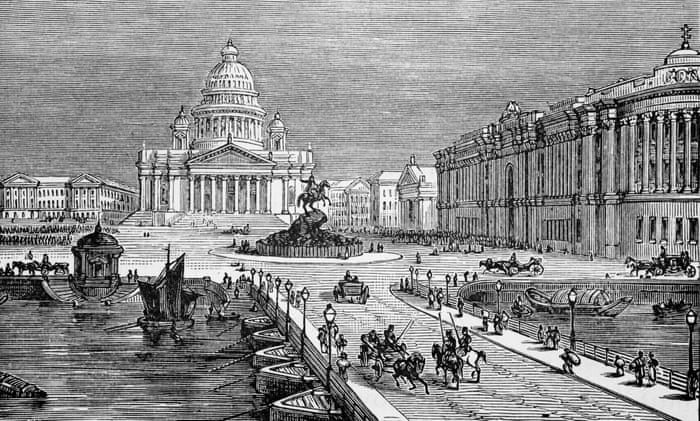
It’s one or two years after an EMP attack and you are safely tucked away in your retreat somewhere in the middle of nowhere. Your storage foods have mostly been used and your high tech electronics is useless. The really bad stuff is mostly past. Now it’s try to stay fed and alive and pray that civilization as you know it is coming back. You’re going to have to work your environment to live. Ever wonder what life might be like? What would it really be like to have no running water, electricity, sewer, newspaper or Internet? No supermarket or fire department close at hand?
I have a good imagination but I decided to talk to someone who would know first hand what it was like: my mother. She grew up on a homestead in the middle of Montana during the 1920s and 1930s. It was a two room Cottonwood cabin with the nearest neighbor three miles away. She was oldest at 9, so she was in charge of her brother and sister. This was her reality; I feel there are lessons here for the rest of us.
There was a Majestic stove that used wood and coal. The first person up at four thirty A.M., usually her father, would start the fire for breakfast. It was a comforting start to the day but your feet would get cold when you got out of bed.
A crosscut saw and axe was used to cut wood for the stove and after that experience, you got pretty stingy with the firewood because you know what it takes to replace it. The old timers say that it warms you when you cut it, when you split it, and again when you burn it. The homes that were typical on homesteads and ranches of the era were smaller with lower ceilings than modern houses just so they could be heated easier. The saw and axe were not tools to try hurrying with. You set a steady pace and maintained it. A man in a hurry with an axe may loose some toes or worse. One side effect of the saw and axe use is that you are continuously hungry and will consume a huge amount of food. Lights in the cabin were old fashioned kerosene lamps. It was the kid’s job to trim the wicks, clean the chimneys and refill the reservoirs.
The privy was downhill from the house next to the corral and there was no toilet paper. Old newspaper, catalogs or magazines were used and in the summer a pan of barely warm water was there for hygiene. During a dark night, blizzard, or brown out from a dust storm, you followed the corral poles-no flashlights.
There were two springs close to the house that ran clear, clean, and cold water. The one right next to it was a “soft” water spring. It was great for washing clothes and felt smooth, almost slick, on your skin. If you drank from it, it would clean you out just as effectively as it cleaned clothes. Not all clean water is equal.
The second spring was a half mile from the cabin and it was cold, clear, and tasted wonderful. The spring itself was deep – an eight foot corral pole never hit bottom- and flowed through the year. It was from here that the kids would fill two barrels on a heavy duty sled with water for the house and the animals. They would lead the old white horse that was hitched to the sledge back to the buildings and distribute the water for people and animals. In the summer, they made two trips in the morning and maybe a third in the evening. In the winter, one trip in the morning and one in the evening. They did this alone.
Breakfast was a big meal because they’re going to be working hard. Usually there would be homemade sausage, eggs and either cornmeal mush or oatmeal. More food was prepared than what was going to be eaten right then. The extra food was left on the table under a dish towel and eaten as wanted during the day. When evening meal was cooked, any leftovers were reheated. The oatmeal or the mush was sliced and fried for supper. It was served with butter, syrup, honey or molasses.
The homemade sausage was from a quarter or half a hog. The grinder was a small kitchen grinder that clamped on the edge of a table and everybody took turns cranking. When all the hog had been ground, the sausage mix was added and kneaded in by hand. Then it was immediately fried into patties. The patties were placed, layer by layer, into a stone crock and covered with the rendered sausage grease. The patties were reheated as needed. The grease was used for gravies as well as re-cooking the patties. Occasionally a fresh slice of bread would be slathered with a layer of sausage grease and a large slice of fresh onion would top it off for quick sandwich. Nothing was wasted.
Some of their protein came from dried fish or beef. Usually this had to be soaked to remove the excess salt or lye. Then it was boiled. Leftovers would go into hash, fish patties, or potato cakes.The kitchen garden ran mostly to root crops. Onion, turnip, rutabaga, potato and radishes grew under chicken wire. Rhubarb was canned for use as a winter tonic to stave off scurvy. Lettuce, corn, and other above ground crops suffered from deer, rats, and gumbo clay soil. Surprisingly, cabbage did well. The winter squash didn’t do much, only 2 or 3 gourds. Grasshoppers were controlled by the chickens and turkeys. There was endless hoeing.
Washing clothes required heating water on the stove, pouring it into three galvanized wash tubs-one for the homemade lye soap and scrub board, the other two for rinsing. Clothes were rinsed and wrung out by hand, then hung on a wire to dry in the air. Your hands became red and raw, your arms and shoulders sore beyond belief by the end of the wash. Wet clothing, especially wool, is heavy and the gray scum from the soap was hard to get out of the clothes.
Personal baths were in a galvanized wash tub screened by a sheet. In the winter it was difficult to haul, heat and handle the water so baths weren’t done often. Most people would do sponge baths.Everybody worked including the kids. There were always more chores to be done than time in the day. It wasn’t just this one family; it was the neighbors as well. You were judged first and foremost by your work ethic and then your honesty. This was critical because if you were found wanting in either department, the extra jobs that might pay cash money, a quarter of beef, hog or mutton would not be available. Further, the cooperation with your neighbors was the only assurance that if you needed help, you would get help. Nobody in the community could get by strictly on their own. A few tried. When they left, nobody missed them. You didn’t have to like someone to cooperate and work with him or her.
Several times a year people would get together for organized activities: barn raising, butcher bee, harvest, roofing, dance, or picnics. There were lots of picnics, usually in a creek bottom with cottonwoods for shade or sometimes at the church. Always, the women would have tables groaning with food, full coffee pots and, if they were lucky, maybe some lemonade. (Lemons were expensive and scarce) After the work (even for picnics, there was usually a project to be done first) came the socializing. Many times people would bring bedding and sleep out overnight, returning home the next day.
A half dozen families would get together for a butcher bee in the cold days of late fall. Cows were slaughtered first, then pigs, mutton, and finally chickens. Blood from some of the animals was collected in milk pails, kept warm on a stove to halt coagulation and salt added. Then it was canned for later use in blood dumplings, sausage or pudding. The hides were salted for later tanning; the feathers from the fowl were held for cleaning and used in pillows or mattresses. The skinned quarters of the animals would be dipped into cold salt brine and hung to finish cooling out so they could be taken home safely for processing. Nothing went to waste.
The most feared occurrence in the area was fire. If it got started, it wasn’t going out until it burned itself out. People could and did loose everything.
The most used weapon was the .22 single shot Winchester with .22 shorts. It was used to take the heads off pheasant, quail, rabbit and ducks. If you held low, the low powered round didn’t tear up the meat. The shooters, usually the kids, quickly learned sight picture and trigger control although they never heard those terms. If you took five rounds of ammunition, you better bring back the ammunition or a critter for the pot for each round expended. It was also a lot quieter and less expensive [in those days] than the .22 Long Rifle cartridges.If you are trying to maintain a low profile, the odor of freshly baked bread can be detected in excess of three miles on a calm day. Especially by kids.
Twice a year the cabin was emptied of everything. The walls, floors, and ceilings were scrubbed with lye soap and a bristle brush. All the belongings were also cleaned before they came back into the house. This was pest control and it was needed until DDT became available. Bedbugs, lice, ticks and other creepy crawlies were a fact of life and were controlled by brute force. Failure to do so left you in misery and maybe ill.Foods were stored in bug proof containers. The most popular was fifteen pound metal coffee cans with tight lids. These were for day to day use in the kitchen. (I still have one. It’s a family heirloom.) The next were barrels to hold the bulk foods like flour, sugar, corn meal, and rice. Everything was sealed or the vermin would get to it. There was always at least one, preferably two, months of food on hand. If the fall cash allowed, they would stock up for the entire winter before the first snowfall.
The closest thing to a cooler was a metal box in the kitchen floor. It had a very tight lid and was used to store milk, eggs and butter for a day or two. Butter was heavily salted on the outside to keep it from going rancid or melting. Buttermilk, cottage cheese and regular cheese was made from raw milk after collecting for a day or two. The box was relatively cool in the summer and did not freeze in the winter.
Mice and rats love humanity because we keep our environment warm and tend to be sloppy with food they like. Snakes love rats and mice so they were always around. If the kids were going to play outside, they would police the area with a hoe and a shovel. After killing and disposing of the rattlesnakes- there was always at least one-then they could play for a while in reasonable safety.
The mice and rats were controlled by traps, rocks from sling shots, cats and coyotes. The cats had a hard and usually short life because of the coyotes. The coyotes were barely controlled and seemed to be able to smell firearms at a distance. There were people who hunted the never-ending numbers for the bounty.
After chores were done, kid’s active imagination was used in their play. They didn’t have a lot of toys. There were a couple of dolls for the girls, a pocket knife and some marbles for the boy, and a whole lot of empty to fill. Their father’s beef calves were pretty gentle by the time they were sold at market – the kids rode them regularly. (Not a much fat on those calves but a lot of muscle.) They would look for arrow heads, lizards, and wild flowers. Chokecherry, buffalo berry, gooseberry and currants were picked for jelly and syrups. Sometimes the kids made chokecherry wine.
On a hot summer day in the afternoon, the shade on the east side of the house was treasured and the east wind, if it came, even more so. Adults hated hailstorms because of the destruction, kids loved them because they could collect the hail and make ice cream.
Childbirth was usually handled at a neighbor’s house with a midwife if you were lucky. If you got sick you were treated with ginger tea, honey, chicken soup or sulphur and molasses. Castor oil was used regularly as well. Wounds were cleaned with soap and disinfected with whisky. Mustard based poultices were often used for a variety of ills. Turpentine, mustard and lard was one that was applied to the chest for pneumonia or a hacking cough.Contact with the outside world was an occasional trip to town for supplies using a wagon and team. A battery operated radio was used very sparingly in the evenings. A rechargeable car battery was used for power. School was a six mile walk one way and you brought your own lunch. One school teacher regularly put potatoes on the stove to bake and shared them with the kids. She was very well thought of by the kids and the parents.
These people were used to a limited amount of social interaction. They were used to no television, radio, or outside entertainment. They were used to having only three or four books. A fiddler or guitar player for a picnic or a dance was a wonderful thing to be enjoyed. Church was a social occasion as well as religious.
The church ladies and their butter and egg money allowed most rural churches to be built and to prosper.The men were required to do the heavy work but the ladies made it come together. The civilizing of the west sprang from these roots. Some of those ladies had spines of steel. They needed it. That’s a partial story of the homestead years. People were very independent, stubborn and strong but still needed the community and access to the technology of the outside world for salt, sugar, flour, spices, chicken feed, cloth, kerosene for the lights and of course, coffee. There are many more things I could list. Could they have found an alternative if something was unavailable? Maybe. How would you get salt or nitrates in Montana without importing? Does anyone know how to make kerosene? Coffee would be valued like gold. Roasted grain or chicory just didn’t cut it.
I don’t want to discourage people trying to prepare but rather to point out that generalized and practical knowledge along with a cooperative community is still needed for long term survival. Whatever shortcomings you may have, if you are part of a community, it is much more likely to be covered. The described community in this article was at least twenty to thirty miles across and included many farms and ranches as well as the town. Who your neighbors are, what type of people they are, and your relationship to them is one of the more important things to consider.
Were there fights, disagreements and other unpleasantness? Absolutely. Some of it was handled by neighbors, a minister or the sheriff. Some bad feelings lasted a lifetime. There were some people that were really bad by any standard and they were either the sheriff’s problem or they got sorted out by one of their prospective victims.
These homesteaders had a rough life but they felt they had a great life and their way of life was shared by everyone they knew. They never went hungry, had great daylong picnics with the neighbors, and knew everyone personally within twenty miles. Every bit of pleasure or joy was treasured like a jewel since it was usually found in a sea of hard work. They worked hard, played hard and loved well. In our cushy life, we have many more “things” and “conveniences” than they ever did, but we lack the connection they had with their environment and community.The biggest concern for our future: What happens if an event such as a solar flare, EMP, or a plague takes our society farther back than the early 1900s by wiping out our technology base. Consider the relatively bucolic scene just described and then add in some true post-apocalyptic hard cases. Some of the science fiction stories suddenly get much more realistic and scary. A comment out of a Star Trek scene comes to mind “In the fight between good and evil, good must be very, very good.”
Consider what kind of supplies might not be available at any cost just because there is no longer a manufacturing base or because there is no supply chain. In the 1900s they had the railroads as a lifeline from the industrial east.One of the greatest advantages we have is access to a huge amount of information about our world, how things work and everything in our lives. We need to be smart enough to learn/understand as much as possible and store references for all the rest. Some of us don’t sleep well at night as we are well aware of how fragile our society and technological infrastructure is. Trying to live the homesteader’s life would be very painful for most of us. I would prefer not to. I hope and pray it doesn’t ever come to that.How long would it take us to rebuild the tools for recovery to the early 1900 levels? Beans? There was almost always a pot of beans on the stove in the winter time. Chickens and a couple of milk cows provided needed food to balance the larder. They could not have supported a growing family without these two resources.
-
50 Tips From The Great Depression- The Great Depression Was One Of The Most Traumatic Events In American History
The Great Depression was one of the most traumatic events in American history. Following the stock market crash of October 1929, industrial production crashed, construction shrank to a fraction of what it had been and millions of people found themselves on short hours or without work. Until the economy picked up again in 1935 life was a real struggle for the average American.
To get through the economic collapse and the grinding poverty that followed it, people had to adapt and learn new skills – or re-learn old ones. For that reason, many people who lived through it looked back with a sense of, maybe not exactly nostalgia, but pride in how they managed to cope.
A lot of the things people did during the Great Depression still make a lot of sense today. With our own economy looking vulnerable, and the risk of a new collapse always lurking just around the corner, would we cope as well as our grandparents and great-grandparents did? Here are some of the ways they took care of themselves and those around them through some of the hardest times the USA has ever seen.
Work
- Entire families moved in search of work. By staying together, they could support each other while not missing employment opportunities.
- Migrant farm work was a life-saver for many. Different crops needed harvesting at different times, so it was – and still is – possible to find several months’ work.
- People were willing to try any job. They didn’t ask “Do you have any work for a…?” But, “Do you have any work?” They were flexible because they had to be.
- Everyone in a family was prepared to earn money. Kids could make a valuable contribution too. Families worked for a common goal – earning enough to survive.
 Almost anything had some value. Driftwood collected from the beach could be split and sold as firewood. Most any kind of metal can be collected and sold as scrap.
- Government “New Deal” employment programs provided jobs and taught skills. They also created a lot of new infrastructure, including many roads – and the Hoover Dam.
- There was no such thing as retirement age. Anyone who could work did When money is tight, everyone needs to contribute whatever they can earn.
- A lot of jobs became part-time as employers tried to save money. Many people worked several part-time jobs, often putting in very long days.
- Many of the jobless spent all day going round employers, looking for any work they could find. Even an hour or two’s labor would make a difference.
- People created jobs for themselves. Some women would wake early to cook dozens of meals, then sell them outside factories and construction sites.
- Flexibility helped. Someone who knew a little about several trades had a better chance of finding work than someone who was an expert at one.
- Farmers would take on workers they didn’t have the money to hire, and pay them in produce instead.
Housing
- Many people lost their homes. Often, extended families – grandparents, aunts, uncles – ended up living in one house.
- Others were forced to live in their car or truck, buying cheap meals and washing at public gyms or swimming pools.
 The homeless often lived in tents – or shack or lean-tos they’d built themselves. Having a place to live, even a basic one, was better than sleeping rough.
- To save energy, walls were insulated with anything that would help keep heat in through the winter – mud, newspapers or tar paper. It all helped cut fuel costs.
- Homes were kept cooler than normal. Wearing more clothes indoors reduced the need to burn fuel, and that left more money for food.
- In summer people hung wet sheets over doorways and windows. As the water evaporated it drew in heat from the air, cooling the home slightly.
- Refinancing a home was one way to keep up the payments – and it could also free up cash for living expenses.
Money
 Life insurance policies were a safety net for those who had them. If money ran out the policy could be cashed in, helping keep the family afloat for a few more months.
- Many people rarely saw cash; barter economies quickly grew up. Small jobs might be paid with milk, fresh vegetables or fruit, especially in rural areas.
- With millions out of work, begging was common – and seen as desperation, not antisocial behavior. Outside restaurant was a favorite spot; only the rich could afford to eat there.
- People respected banks back then, but when banks started closing the trust soon faded. Nobody knew when their own might shut, so the wise kept cash at home.
- Many stores gave credit and let regular payments slide. They just kept track of what was owed and hoped it would be paid someday. Many stores went bankrupt because of this.
Food
- Having a vegetable plot made a huge difference. In 1929, 20% of Americans still lived on farms; most of the rest had big gardens, and the skills to grow their own food.
- Hunting and fishing were major sources of protein. Meat was expensive, but if you could harvest your own you had a better diet. Surplus was great for barter, too.
- Foraging was also popular. Nuts, berries, and wild greens helped put meals on the table, and kids and older people could forage as well as anyone.
- In the country, canning was an essential skill. A well-stocked pantry was both a source of pride and a life-saving reserve for the winter.
 People learned that you can eat almost anything if you’re hungry enough. Tumbleweed was used as fodder for cattle; then people found it could be eaten. Young plants are best.
- No part of an animal was wasted. Offal was fried, boiled or turned into ground meat. Even chicken feet could be boiled to add some taste to a broth.
- A little bit of bacon would add flavor to almost anything. The hard rinds or dry ends of a piece of bacon could be boiled – and butchers sold them for pennies.
- Communities divided vacant lots and parks into family vegetable plots. Housewives and kids spent much of their time growing extra food.
- To keep some variety in their diets, people traded the produce they grew with friends and neighbors.
- Meals were cooked from scratch – there were hardly any prepared foods in the shops. Recipes were usually simpler than today’s. That mean they were cheaper to make.
- Stores closed on Sundays, so fresh produce that would go bad by Monday would be sold off cheap late on Saturday. Shopping at that time was great for bargains.
- Livestock was a great asset. If you had a cow or even a few chickens, you were sitting on a wealth creator. Milk and eggs helped your own diet, and could be bartered.
- Meat and dairy products were expensive; bread, potatoes, and noodles were cheap and filling. People bulked out meals with carbohydrates. Lard or bacon fat added flavor.
- Soup was a popular meal. It filled you up, and the main ingredient was water. Almost anything could be made into soup – beans, potatoes, even stale bread.
Clothes
- Shoes were mended over and over. Holes in the sole were patched with leather from scrap belts or purses. Complete soles were cut from old tires.
 People learned to make and repair clothes. Any fabric could be used. Rural families made clothes from feed sacks. One woman turned a casket’s fabric lining into kids’ dresses.
- Fashion was canceled. People preferred to get more use out their old clothes and spend their money on food.
- When kids outgrew their clothes they were handed down to younger siblings or given to people who could use them.
- Really old clothes were cut up for rags to get some more use out of them. Why spend money on dusters and cleaning cloths when rags worked just as well?
Society and Attitudes
- Nobody felt entitled to be supported. People knew that they had to work as hard as they could to survive; if they didn’t, they could expect nothing.
- On the other hand, people were willing to help those who were trying but struggling. They knew they could be the ones needing help next, so most gave all they could spare.
 Communities became closer, giving mutual support and organizing donations of food or cash to those who needed them the most.
- Many towns set up welfare loan schemes. Money could be loaned to people who needed it, but it was expected to be paid back. Detailed records were kept of what was owed.
- Willingness to work hard, and to do what you could to support the community, was more highly valued than individualism and independence.
- People learned to keep a positive outlook on life. They learned that they could lose a surprising amount – almost everything – and keep going.
- Positivity was essential. There was no point complaining how bad things were – they were just as bad for almost everyone. What mattered was trying to make them better.
-
Subscribe
Subscribed
Already have a WordPress.com account? Log in now.
 Site Title